All in all an excellent talk by Dr. Peter Kreeft on prayer:
Showing posts with label Heavenly Wisdom. Show all posts
Showing posts with label Heavenly Wisdom. Show all posts
Tuesday, November 15, 2011
PRAYER
Funny and witty, practical and helpful.
All in all an excellent talk by Dr. Peter Kreeft on prayer:
All in all an excellent talk by Dr. Peter Kreeft on prayer:


Wednesday, November 2, 2011
Monday, October 24, 2011
Vocation in the words of Bl. JPII
"Do not be afraid of the radicalness of His demands, because Jesus, who loved us first, is prepared to give Himself to you, as well as asking of you. If He asks much from you, it is because He knows you can give much." ~Bl. JPII
 "I would like to ask each one of you: What will you do with your life? What are your plans? Have you ever thought of committing your existence totally to Christ? Do you think that there can be anything greater than to bring Jesus to people and people to Jesus?"
"There is a wonderful way of experiencing love in life: it is the vocation to follow Christ in the celibate state freely chosen or in the state of virginity for the love of the kingdom of heaven. I ask each one of you to question yourselves seriously about whether God may not be calling yo uto one of these paths. And to all of those who suspect that they may have this possible personal vocation, I say: pray insistently to receive the needed clarity, but then reply with a joyful yes."
"Vocation is, therefore, a mystery that man accepts and lives in the depths of his being. A gift and a grace, it depends on supreme divine freedom and, in its total reality, it escapes our understanding. We cannot demand explanations from the Giver of all goods - "Why have you made me thus?" (Rom 9:20) because He who calls is also "He who is" (cf. Ex 3:14). Therefore, in the presence of a vocation we adore the mystery, we respond lovingly to the initiative of love, we say yes to the call."
"You ask me for encouragement and guidance, and most willingly I offer some words of advice to all of you in the name of Jesus Christ. In the first place I say this: you must never think that you are alone in deciding your future! And second: when deciding your future, you must not decide for yourself alone!"
"If some of you hear the call to follow Christ more closely, to dedicate your entire heart to Him, like the apostles John and Paul, be generous, do not be afraid, because you have nothing to fear when the prize that you await is God Himself..."
"How can this be? That is a good question. Our Blessed Lady, Mary of Nazareth, asked that same very question when God's extraordinary plan for her life was first explained to her. And the answer which Mary received from Almighty God is the identical answer that He gives to you: "The Holy Spirit will come upon you and the power of the Most High will cover you with Its shadow...nothing is impossible to God" (Lk 1:34-37).
"Is Jesus perhaps repeating to some of you today: "There is one thing you lack"? Is he perhaps asking for even more love, more generosity, more sacrifice? Yes, the love of Christ involves generosity and sacrifice. To follow Christ and to serve the world in His name requires courage and strength. There is no place for selfishness - and no place for fear! Do not be afraid, then, when love makes demands. Do not be afraid when love requires sacrifice."
"To each one of you I say, therefore: Heed the call of Christ when you hear Him saying to you: "Follow Me!" Walk in My path! Stand by My side! Remain in My love!...Real love is demanding. I would fail in my mission if I did not clearly tell you so. Love demands effort and a personal commitment to the will of God."
"Young people of the world, hear His voice! Hear His voice and follow Him!"
 "I would like to ask each one of you: What will you do with your life? What are your plans? Have you ever thought of committing your existence totally to Christ? Do you think that there can be anything greater than to bring Jesus to people and people to Jesus?"
"There is a wonderful way of experiencing love in life: it is the vocation to follow Christ in the celibate state freely chosen or in the state of virginity for the love of the kingdom of heaven. I ask each one of you to question yourselves seriously about whether God may not be calling yo uto one of these paths. And to all of those who suspect that they may have this possible personal vocation, I say: pray insistently to receive the needed clarity, but then reply with a joyful yes."
"Vocation is, therefore, a mystery that man accepts and lives in the depths of his being. A gift and a grace, it depends on supreme divine freedom and, in its total reality, it escapes our understanding. We cannot demand explanations from the Giver of all goods - "Why have you made me thus?" (Rom 9:20) because He who calls is also "He who is" (cf. Ex 3:14). Therefore, in the presence of a vocation we adore the mystery, we respond lovingly to the initiative of love, we say yes to the call."
"You ask me for encouragement and guidance, and most willingly I offer some words of advice to all of you in the name of Jesus Christ. In the first place I say this: you must never think that you are alone in deciding your future! And second: when deciding your future, you must not decide for yourself alone!"
"If some of you hear the call to follow Christ more closely, to dedicate your entire heart to Him, like the apostles John and Paul, be generous, do not be afraid, because you have nothing to fear when the prize that you await is God Himself..."
"How can this be? That is a good question. Our Blessed Lady, Mary of Nazareth, asked that same very question when God's extraordinary plan for her life was first explained to her. And the answer which Mary received from Almighty God is the identical answer that He gives to you: "The Holy Spirit will come upon you and the power of the Most High will cover you with Its shadow...nothing is impossible to God" (Lk 1:34-37).
"Is Jesus perhaps repeating to some of you today: "There is one thing you lack"? Is he perhaps asking for even more love, more generosity, more sacrifice? Yes, the love of Christ involves generosity and sacrifice. To follow Christ and to serve the world in His name requires courage and strength. There is no place for selfishness - and no place for fear! Do not be afraid, then, when love makes demands. Do not be afraid when love requires sacrifice."
"To each one of you I say, therefore: Heed the call of Christ when you hear Him saying to you: "Follow Me!" Walk in My path! Stand by My side! Remain in My love!...Real love is demanding. I would fail in my mission if I did not clearly tell you so. Love demands effort and a personal commitment to the will of God."
"Young people of the world, hear His voice! Hear His voice and follow Him!"
*All quotes taken from The Meaning of Vocation: In the Words of John Paull II
Thursday, October 20, 2011
Wednesday, September 7, 2011
Saturday, July 23, 2011
"Unrest When We Have Decisions to Make" What to do?

Situations of this type can be very painful and certain dilemmas truly agonizing. The general stance of abandonment and confidence of which we have spoken, this approach of putting everything into the hands of God which enables us to avoid "dramatizing" anything (even the consequences that our errors might engender!) will be particularly precious in these situations of incertitude.
We would like, however, to make a few useful remarks for conserving our interor peace when making decisions.
The first thing to say (and this is in complete harmony with what we have said up to this point) is that, when faced with an important decision, one of the errors to avoid is that of being excessively hurried or precipitous. A certain deliberation is often necessary in order to properly consider things and to allow our hearts to orient themselves peaceably and gently toward a good solution. Saint Vincent de Paul made decisions that were presented to him after mature reflection (and above all prayer!), in such a way that some people who were close to him found him too slow to decide. But, one judges a tree by it's fruit!
Before making a decision, it is necessary to do what is appropriate to see the situation clearly and not to decide precipitously or arbitrarily. We need to analyse the situation with its different aspects and to consider our motivations in order to decide with a pure heart and not in an effort to serve our personal interests. We need to pray for the light of the Holy Spirit and the grace to act in conformity with the will of God and, if necessary, to ask the advice of people who can enlighten us relative to this decision.
In this regard, we must know that everyone will encounter, above all in the spiritual life, certain situations where one would not have sufficient light, would be incapable of making a necessary discernment or of making a determination in peace, without recourse to a spiritual advisor. The Lord does not want us to be self-sufficient and, as part of His pedagogy, He permits that sometimes we find ourselves in the impossibility of finding enlightenment and peace by ourselves; we cannot receive them except through the intermediary of another person to whom we can open up. There is in this opening up of the heart relative to questions that we ask ourselves or dilemmas that we try to solve, a disposition of humility and trust which greatly pleases the Lord and frequently renders harmless the traps that the enemy sets there to decieve or trouble us. Regarding this interior peace, which is so precious and of which we have spoken so much, we know that at certain moments in our lives we cannot find it by ourselves without the help of someone to whome we can open our souls. Saint Alphonsus Liguori was an uparalleled director souls, but with regard to that which concerned his own spiritual life, he was very often incapable of orienting himself with out the aid of someone to whom he opened himself and toward whom he was obedient.
Having said that, it is important to know one thing. Whatever the precautions (prayer, reflection, advice) that one uses to obtain enlightenment before making a decision and in order to be sure of doing God's will (it's a duty to take these precautions, becuase we do not have the right, above all in domains of importance, to decide lightly), one will not always receive this light in a clear and unambiguous manner. Confronted with a specific situation, we ask ourselves (and we must always do this!): "What must I do? What is the Lord's will?" We will not always have a response!
When we make this effort at discernment and search for God's will, often the Lord speaks to us in diverse ways and makes us understand in a clear way how we must act. Then we can make our decision in peace.
But, it may happen that the Lord does not respond to us. And this is completely normal. Sometimes, He simply leaves us free and sometimes, for reasons of His own, He does not manifest Himself. It is good to know this, because if often happens that people, for fear of making a mistake, of not doing the will of God, seek at any price to have an answer. They increase their reflections, their prayers, they open the Bible ten times looking for a text in order to obtain the desired enlightenment. And all this is torubling and disquieting more than anything else. We do not see things more clearly for all that; we have a text, but we don't know how to interpret it.
When the Lord leaves us thus in incertitutde, we must quietly accept it. Rather than wanting to "force things" and torment ourselves unnecessarily because we do not have an evident response, we must follow the principle that Saint Faustina offers us:

When one does not know what is best, one must reflect, consider and take counsel, because one does not have the right to act in a incertitude of conscience. In incertitude (if the incertitude remains) one must tell oneself: whatever I do, it will be good, provided that I have the intention to do good. That which we consider good, God accepts and considers as good. Don't be chagrined if, after a certain time, you see that these things are not good. God looks at the intention with which we begin and He grants the reward according to this intention. It is a principle that we must follow.
Often we torment ourselves excessively regarding our decisions. As there is a false humilty, a false compassion, we can also say that, concerning our decisions, there is sometimes that which one could call a "false obedience" to God. We would like always to be absolutely certain of doing God's will in all of our choices and never to be mistaken. But there is, in this attitude, something that is not exactly right for a variety of reasons.
For one thing, this desire to know what God wants sometimes hides a difficulty in enduring a situation of incertitude. We want to be released from having to decide by ourselves. But, frequently, the will of the Lord is that we do decide for ourselves, even if we are not absolutely sure that this decision would be the best. In effect, in this capacity to decide in incertitude, in doing that which seems to us best without spending hours equivocating, there is an attitude of confidence and abandonment: "Lord, I have thought about it and prayed to know Your will. I do not see it clearly, but I am not going to trouble myself any further. I am not going to spend hours racking my brain. I am decidding such and such a thing because, all things carefully considered, it seems to me the best thing to do. And I leave everything in Your hands. I know well that, even if I am mistaken, You will not be displeased with me, for I have acted with good intentions. and if I have made a mistake, I know that You are able to draw good from this error. It will be for me a source of humilty and I will learn something from it!" And I remain at peace.
For another thing, we would love to be infallible, to never be wrong, but there is a lot of pride in this desire and there is also the fear of being judged by others. The one, on the contrary, who accepts peacefully the idea of being wrong from time to time and accepts that others know it manifests true humility and a true love of God.
On the other hand, let us not have a false idea of what God requires of us. God is our Father, good and compassionate, Who knows the shortcomings of His children, the limitations of our judgment. He asks of us goodwill, the right intentions, but in no way does He demand that we would be infallible and that all of our decisions would be perfect! And additionally, if all our decisions were perfect, this would, without doubt, do us more harm than good! We would quickly take ourselves for supermen.
To conclude, the Lord loves him more who knows how to decide for himself without equivocating, even when he is uncertain, and who abandons himself with confidence to God as to the consequences, rather than the one who torments his spirit unceasingly in an effort to know what God expects of him and who never decides. Because, there is, in the first attitude, more abandonment, confidence and therefore love, than in the second. God loves those who make their way with freedom of spirit and who don't "split hairs" too much over the details. Perfectionism doesn't have much to do with sanctity.
It is important also to know well how to distinguish those cases where it is necessary to take time to discern and to decide, when it is a matter of decisions, for example, that affect our entire lives and the opposite cases where it would be stupid and contrary to the will of God to take too much time and too many precautions before deciding, when there is not much difference between one choice and another. As Saint Francis de Sales said, "If it is normal to weigh gold ingots with care, when it comes to small coins it is enough to make a quick evaluation." The devil, who is always seeking to disturb us, makes us ask ourselves, even in making the smallest decision, whether it is truly the will of the Lord or not to do thus and who creates unease, scruples and remorse of conscience for things that really aren't worth the trouble.
We must have a constant and profound desire to obey God. But this desire will be truly in accord with the Holy Spirit if it is accompanied by peace, interior freedom, confidence and abandonment and not if it is a source of trouble which paralyzes the conscience and prevents one from deciding freely.
It is true that the Lord can permit moments where this desire to obey Him causes real torment. There is also the case of persons who are scrupulous by temperament; this is a very painful trial from which the Lord never totally delivers them in this life.
But, it is still true that normally we must strive to advance along our path in such a fashion, in internal freedom and peace. And to know, as we have just said, that the devil tries passionately to trouble us. He is crafty and uses the desire we have to do God's will to disturb us. One must not let him "take advantage" of us. When one is far from God, the adversary tempts him with evil: he attracts him to the bad things. But when one is close to God, loves Him, desires nothing but to please and obey Him, the devil, while he tempts him still with evil (this is easy to recognize), he tempts him even further by good. This means that he makes use of our desire to do good to trouble us. He does this by making us scrupulous, or by presenting us with a certain good that we must realize but which is beyone our present strength, or which is not what God asks of us - all to discourage us or to cause us to lose our peace. He wants to convince us that we are not doing enough or that what we are doing we are not really doing for the love of God, or that the Lord is not happy with us, etc. He would make us believe, for instance, that the Lord is asking such and such a sacrifice of us that we are incapable of doing, and this will trouble us greatly. It creates all sorts of scruples and worries in the conscience which we should purely and simply ignore, while throwing ourselves into the arms of God like small children. When we lose peace for reasons similar to those we just mentioned, let us tell ourselves that the devil must be involved. Let's try to regain our calm and, if we cannot do it by ourselves, we should open up to a spiritual person. The mere fact of speaking to another person will generally be enough to make our confusion disappear completely and to bring back our peace.
Regarding this spirit of freedom that should animate us in all our actions and decisions, let us conclude by listening to Saint Francis de Sales:

Keep your heart open and always in the hands of Divine Providence, whether great things or small, and obtain for your heart more and more the spirit of gentleness and tranquility. (Letter to Mme. De la Flechere, 13 may 1609) The word that I spoke to you so often was that you should not be too particular in the excercise of virtues, rather that you should pursue them briskly, openly, naively, in an old-fashioned way, with liberty, sincerity and grosso modo. It is because I fear the spirit of constraint and melancholy. It is my wish that you should have a large and open heart on the way to our Lord."
*Taken from Searching for and Maintaing Peace: A Small Treatise on Peace of Heart by Jacques Philippe, SJ, Pg. 69-78
Monday, May 16, 2011
On Holiness and Purity of Heart

All of us are to journey into holiness and purity of heart. It is easy to picture laymen saying parish priests are called to holiness, diocesan priests saying the religious orders are called to holiness, the religious saying the Trappists are called to holiness, the Trappists saying the Carthusians are called to holiness, the Carthusians saying only God is holy. This unholy passing of the buck is not the word of God.
"The Lord Jesus, the divine Teacher and Model of all perfections, preached holiness of life to each and every one of his disciples, regardless of their situation: 'You must therefore be perfect just as your heavenly Father is perfect (Mat 5:48).'"
Again the council fathers say, 'Thus it is evident to everyone that all the faithful of Christ of whatever rank or status are called to the fullness of the Christian life and to perfections of charity." The Vatican Council is the clearest statement ever that the journey into purity of heart is for each and every one of us."
~Joseph Breult, Seeking Purity of Heart: The Gift of Ourselves to God
*Emphasis added
Monday, February 28, 2011
Food for Thought

"I will lead the blind on their journey; by paths unknown I will guide them. I will turn darkness into light before them, and make crooked ways straight."
~ Isaiah 42: 16
Friday, February 18, 2011
"Our Heart Longs for God"
By St. Augustine, Bishop
 We have been promised that we shall be like him, for we shall see him as he is. By these words, the tongue has done its best; now we must apply the meditation of the heart. Although they are the words of Saint John, what are they in comparison with the divine reality? And how can we, so greatly inferior to John in merit, add anything of our own? Yet we have received, as John has told us, an anointing by the Holy One which teaches us inwardly more than our tongue can speak. Let us turn to the is source of knowledge, and because at present you cannot see, make it your business to desire the divine vision.
The entire life of a good Christian is in fact an exercise of holy desire. You do not yet see what you long for, but the very act of desiring prepares you, so that when he comes you may see and be utterly satisfied.
Suppose you are going to fill some holder or container, and you know you will be given a large amount. Then you set about stretching your sack or wineskin or whatever it is. Why? Because you know the quantity you will have to put in it and your eyes tell you there is not enough room. By stretching it, therefore, you increase the capacity of the sack, and this is how God deals with us. Simply by making us wait he increases our desire, which in turn enlarges the capacity of our soul, making it able to receive what is to be given to us.
So my brethren, let us continue to desire, for we shall be filled. Take not of Saint Paul stretching as it were his ability to receive what is to come: Not that I have already obtained this, he said, or am I made perfect. Brethren, I do not consider that I have already obtained it. We might ask him, "If you have not yet obtained it, what are you doing in this life?" This one thing I do, answers Paul, forgetting what lies behind, and stretching forward to what lies ahead, I press on toward the prize to which I am called in the life above. Not only did Paul say he stretched forward, but he also declared that he pressed on toward a chosen goal. He realized in fact that he was still short of receiving what no eye has seen, nor ear heard, nor the heart of man conceived.
Such is our Christian life. By desiring heaven we exercise the powers of our soul. Now this exercise will be effective only to the extent that we free ourselves from desires leading to infatuation with this world. Let me return to the example I have already used, of filling an empty container. God means to fill each of you with what is good; so cast out what is bad! If he wished to fill you with honey and you are full of sour wine, where is the honey to go? The vessel must be emptied of its contents and then be cleansed. Yes, it must be cleansed even if you have to work hard and scour it. It must be made fit for the new thing, whatever it may be.
We may go on speaking figuratively of honey, gold or wine - but whatever we say we cannot express the reality we are to receive. The name of that reality is God. But who will claim that in that one syllable we utter the full expanse of our heart's desire? Therefore, whatever we say is necessarily less than the full truth. We must extend ourselves toward the measure of Christ so that when he comes he may fill us with his presence. Then we shall be like him, for we shall see him as he is.
*Taken from the LOTH, Sixth Week in OT, Friday Office of Readings, 2nd Reading. Emphasis added.
We have been promised that we shall be like him, for we shall see him as he is. By these words, the tongue has done its best; now we must apply the meditation of the heart. Although they are the words of Saint John, what are they in comparison with the divine reality? And how can we, so greatly inferior to John in merit, add anything of our own? Yet we have received, as John has told us, an anointing by the Holy One which teaches us inwardly more than our tongue can speak. Let us turn to the is source of knowledge, and because at present you cannot see, make it your business to desire the divine vision.The entire life of a good Christian is in fact an exercise of holy desire. You do not yet see what you long for, but the very act of desiring prepares you, so that when he comes you may see and be utterly satisfied.
Suppose you are going to fill some holder or container, and you know you will be given a large amount. Then you set about stretching your sack or wineskin or whatever it is. Why? Because you know the quantity you will have to put in it and your eyes tell you there is not enough room. By stretching it, therefore, you increase the capacity of the sack, and this is how God deals with us. Simply by making us wait he increases our desire, which in turn enlarges the capacity of our soul, making it able to receive what is to be given to us.
So my brethren, let us continue to desire, for we shall be filled. Take not of Saint Paul stretching as it were his ability to receive what is to come: Not that I have already obtained this, he said, or am I made perfect. Brethren, I do not consider that I have already obtained it. We might ask him, "If you have not yet obtained it, what are you doing in this life?" This one thing I do, answers Paul, forgetting what lies behind, and stretching forward to what lies ahead, I press on toward the prize to which I am called in the life above. Not only did Paul say he stretched forward, but he also declared that he pressed on toward a chosen goal. He realized in fact that he was still short of receiving what no eye has seen, nor ear heard, nor the heart of man conceived.
Such is our Christian life. By desiring heaven we exercise the powers of our soul. Now this exercise will be effective only to the extent that we free ourselves from desires leading to infatuation with this world. Let me return to the example I have already used, of filling an empty container. God means to fill each of you with what is good; so cast out what is bad! If he wished to fill you with honey and you are full of sour wine, where is the honey to go? The vessel must be emptied of its contents and then be cleansed. Yes, it must be cleansed even if you have to work hard and scour it. It must be made fit for the new thing, whatever it may be.
We may go on speaking figuratively of honey, gold or wine - but whatever we say we cannot express the reality we are to receive. The name of that reality is God. But who will claim that in that one syllable we utter the full expanse of our heart's desire? Therefore, whatever we say is necessarily less than the full truth. We must extend ourselves toward the measure of Christ so that when he comes he may fill us with his presence. Then we shall be like him, for we shall see him as he is.
*Taken from the LOTH, Sixth Week in OT, Friday Office of Readings, 2nd Reading. Emphasis added.
Thursday, December 30, 2010
Quote of the Day: Pope John Paul II on the Incarnation

~Pope John Paul II
Wednesday, December 15, 2010
Quote of the Day: St. John of the Cross

"In solitude He guides her, He alone, Who also bears in solitude, the wound of love."
~St. John of the Cross
Feast day: December 14th
Saturday, November 13, 2010
Tuesday, October 5, 2010
St. Faustina, Pray for us!

"Let no soul fear to draw near to Me, even though its sins be as scarlet. My mercy is so great that no mind, be it of man or of angel, will be able to fathom it throughout all eternity."
~Jesus to St. Faustina, Diary 699
"If souls would put themselves completely in my care, I myself would undertake the task of sanctifying them, and I would lavish even greater graces on them. There are souls who thwart My efforts, but I have not given up on them; as often as they turn to Me, I hurry to their aid, sheilding them with My mercy, and I give them the first place in My compassionate Heart.
~Jesus to St. Faustina, Diary 59
Related Posts: Divine Mercy, On the Life of St. Faustina
Thursday, September 23, 2010
St. Padre Pio

"I can refuse no one. How could I when the Lord never refuses me a grace."
"Pray, hope, and don't worry. Worry is useless. God is merciful and will hear your prayer."
"Bring me my 'weapon'!" (The Rosary)
"You must speak to Jesus also with the heart, besides with the lips; indeed, in certain cases you must speak to Him only with the heart."
"Have courage and do not fear the assaults of the Devil. Remember this forever; it is a healthy sign if the devil shouts and roars around your conscience, since this shows that he is not inside your will."
"If we only knew how God regards thus Sacrifice, we would risk our lives to be present at a single mass. Every Holy Mass heard with devotion, produces in our souls marvelous effects, abundant spiritual and material graces, which we, ourselves, do not know."
"Believe me, to live happily in this pilgrimage; we have to aim at the hope of arriving at our Homeland, where we will stay eternally. Meanwhile we have to believe firmly that God calls us to Himself and follows us along the path towards Him. He will never permit anything to happen to us that is not for our greater good. He knows who we are and He will hold out His paternal hand to us during difficulties, so that nothing prevents us from running to Him swiftly. But to enjoy this grace we must have complete trust in Him."
"Jesus said to me; 'How many times would you have abandoned Me, my Son, if I had not crucified you. Beneath the cross, one learns love, and I do not give this to everyone, but only to those souls who are dearest to Me."
"You should not be discouraged, because if there is in the soul a continual effort to improve, the Lord will finally reward you by suddenly making all the virtues blossom in you as in a garden full of flowers."
"Fear not, because God is with you...The longer the trial to which God subjects you, the greater the goodness in comforting you during the time of the trial and in the exaltation after the combat."
"Yes, I love the cross, the cross alone. I love it because I always see it behind Jesus' shoulders."

"It is to your advantage to commit yourself to the sufferings that Jesus will send to you. Jesus cannot tolerate seeing you afflicted and he will come to you and comfort you, blessing you with many graces for your soul."
"My heart feels as if it were being drawn by a superior force each morning just before uniting with Him in the Blessed Sacrament. I have such a thirst and hunger before receiving Him that it's a wonder I don't die of anxiety. I was hardly able to reach the Divine Prisoner in order to celebrate Mass. When Mass ended I remained with Jesus to render Him thanks. My thirst and hunger do not diminish after I have received Him in the Blessed Sacrament, but rather, increase steadily. Oh, how sweet was the conversation I held with Paradise this morning. The Heart of Jesus and my own, if you will pardon my expression, fused. They were no longer two hearts beating but only one. My heart disappeared as if it were a drop in the ocean."
Wednesday, September 15, 2010
Memorial of Our Lady of Sorrows: On the Martyrdom of Mary

"The martyrdom of the Virgin is set forth both in the prophecy of Simeon and in the actual story of our Lord's passion...[Simeon to Mary:] 'And your own heart will be pierced by a sword.'...
Truly, O blessed Mother, a sword has pierced your heart. For only by passing through your heart could the sword enter the flesh of your Son. Indeed, after your Jesus - who belongs to everyone, but is especially yours - gave up His life, the cruel spear, which was not withheld from His lifeless body, tore open His side. Clearly it did not touch His soul and could not harm Him, but it did pierce your heart. For surely His soul was no longer there, but yours could not be torn away. Thus the violence of the sorrow has cut through your heart, and we rightly call you more than martyr, since the effect of compassion in you has gone beyond the endurance of physical suffering.
...For if He could die in body, could she not die with Him in spirit? He died in body through a love greater than anyone had known. She died in spirit through a love unlike any other since His."
(From a Sermon by St. Bernard)
Related Posts: The Stabat Mater
Tuesday, September 14, 2010
The Glory of the Cross

"Anyone who wishes to follow Me must deny self, take up the cross, and follow Me."
(Mt. 16:24)
"May I never boast of anything but the cross of our Lord Jesus Christ!"
~St. Paul
"Jesus said to me; 'How many times would you have abandoned Me, my Son, if I had not crucified you. Beneath the cross, one learns love, and I do not give this to everyone, but only to those souls who are dearest to Me."
~St. Padre Pio
"One cannot desire freedom from the Cross when one is especially chosen for the Cross."
~St. Teresa Benedicta of the Cross (Edith Stein)
"The cross is honorable because it is both the sign of God's suffering and the trophy of His victory."
~St. Andrew of Crete
"We are co-redeemers of the world. And souls are not redeemed without the Cross."
~St. Teresa of the Andes
"Apart from the cross there is no other ladder by which we may get to heaven."
~ Saint Rose of Lima
"Yes, I love the cross, the cross alone. I love it because I always see it behind Jesus' shoulders."
~St. Padre Pio
Related Posts: On Suffering, Feast of the Exaltation of the Holy Cross 2009, More on the Cross
Saturday, August 28, 2010
St. Augustine, Pray for us!

"Faith is to believe what we do not see; and the reward of this faith is to see what we believe."
"God had one Son on earth without sin, but never one without suffering."
"There is no saint without a past, no sinner without a future."
"To fall in love with God is the greatest romance; to seek him the greatest adventure; to find him, the greatest human achievement."
"Thou hast made us for Thyself, O Lord, and our heart is restless until it finds its rest in Thee."
"God has promised forgiveness to your repentance, but He has not promised tomorrow to your procrastination."
"God loves each of us as if there were only one of us."
"Late have I loved You, O Beauty ever ancient, ever new, late have I loved You! You were within me, but I was outside, and it was there that I searched for You. In my unloveliness I plunged into the lovely things which You created. You were with me, but I was not with You. Created things kept me from You; yet if they had not been in You they would have not been at all. You called, You shouted, and You broke through my deafness. You flashed, You shone, and You dispelled my blindness. You breathed Your fragrance on me; I drew in breath and now I pant for You. I have tasted You, now I hunger and thirst for more. You touched me, and I burned for Your peace."
Go here for more on the life of St. Augustine.
Friday, August 27, 2010
Feast of St. Monica
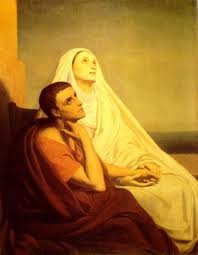
"Son, nothing in this world now affords me delight. I do not know what there is now for me to do or why I am still here, all my hopes in this world being now fulfilled."
(At the conversion of her son, St. Augustine)
Read here for more on the life of St. Monica, patron of mothers and married women.
Sunday, August 15, 2010
HAPPY FEAST OF THE ASSUMPTION OF THE BLESSED VIRGIN MARY!!!

"Your stainless and wholly immaculate body has not been left on earth; the Queen, the Mistress, the Mother of God who has truly given birth to God has been translated to the royal palaces of Heaven...For just as her virginity remained inviolate while giving birth, when she departed her body was preserved from destruction and only taken to a better and more divine tabernacle..."
~St. John Damascene
~St. John Damascene
“In the bodily and spiritual glory which she possesses in heaven, the Mother of Jesus continues in this present world as the image and first flowering of the Church as she is to be perfected in the world to come. Likewise, Mary shines forth on earth, until the day of the Lord shall come (cf. 2 Peter 3:10), as a sign of certain hope and comfort for the pilgrim People of God”
~Dogmatic Constitution on the Church
Saturday, August 14, 2010
St. Maximilian Mary Kolbe, Pray for us!

"For Jesus Christ I am prepared to suffer still more."
Go here for more on St. Maximilian Kolbe.
Subscribe to:
Comments (Atom)